Six Sigma Training West Des Moines
Enquire Today For A Free No Obligation Quote
Welcome to Six Sigma Training US, a trusted leader in process improvement and quality management.
We provide comprehensive Six Sigma programs throughout the United States. Our accredited instructors craft tailored programs and use a practical hands on method that accelerates team growth.
Training outcomes include fewer defects and less variation, higher customer satisfaction and ROI, and stronger problem solving and data driven decisions. Delivery formats include in person, virtual, and on site sessions aligned to your goals.
From dynamic workshops and simulations to focused one on one coaching, our programs deliver results you can see. Drive operational excellence and elevate performance with Six Sigma Training.
What Makes Us the Best Six Sigma Training Provider in the United States?
Our standing in the market reflects consistent delivery of high quality, results driven programs that shape confident, capable practitioners. Courses align with industry standards and are recognized by bodies such as the International Association for Six Sigma Certification and ASQ.
Our Experienced and Qualified Instructors
Instructors bring strong Lean and Six Sigma expertise so participants receive reliable training and clear, practical direction.
Experience across manufacturing, healthcare, technology, finance, and service sectors provides varied examples and insights.
Work across corporate, nonprofit, and public sector organizations gives a balanced view of improvement in multiple contexts.
This variety supports tailored guidance that fits participant needs and challenges, creating an engaging learning experience.
Our Tailored Training Programs
We build flexible programs that match your organization’s needs and use DMAIC, DMADV, and Lean techniques where appropriate.
Our process begins with an assessment to understand metrics, pain points, goals, and culture.
We prioritize processes and capability gaps and design a training and project roadmap that addresses them.
Modular content lets cohorts receive training targeted to roles and business goals.
We adjust delivery format and depth to secure the best outcomes.
Our Focus on Practical Application
Training is anchored in practice. We apply tools, real data sets, and interactive scenarios so participants can use concepts right away.
Through case studies and root cause work, our hands on approach builds confidence and capability in a supportive environment.
What Are the Benefits of Our Six Sigma Training?
Our programs offer numerous benefits, including:
- Clearer communication with stronger cross functional collaboration
- Higher employee engagement and decreased turnover
- Better problem solving and decision making
- Notable improvements in performance and quality
Improved Communication and Teamwork
Our courses promote a common improvement framework and define project roles to enhance communication and teamwork.
Effective communication requires clarity on the voice of the customer, CTQs, and measured process capability.
Training emphasizes active listening, crisp data communication, and structured progress reviews to support a healthy work climate.
Teams apply value stream mapping, FMEAs, and action planning to grow skills and elevate organizational outcomes.
Increased Employee Engagement and Retention
By engaging employees in solving real issues, Six Sigma training drives higher engagement and retention.
Leaders who coach, deliver actionable feedback, and remove friction points help employees feel recognized and committed.
This connection between skill development and engagement increases satisfaction and loyalty.
Firms that invest in Six Sigma report more involvement in improvement projects and stronger retention of experienced employees.
Enhanced Problem Solving and Decision Making Skills
Our training equips teams with DMAIC discipline, statistical thinking, and visual management to improve decisions.
Leaders handle complexity, from throughput constraints to quality slips, using structured, data informed approaches.
Earlier, higher quality decisions reduce cycle time and waste while fueling innovation.
Capabilities gained help teams align initiatives to business priorities and use evidence to capture opportunities and hold improvements.
What Are the Different Types of Six Sigma Training We Offer?
We provide several options to align with different learning preferences and organizational priorities, including face to face training, virtual training, and on site programs.
In Person Training
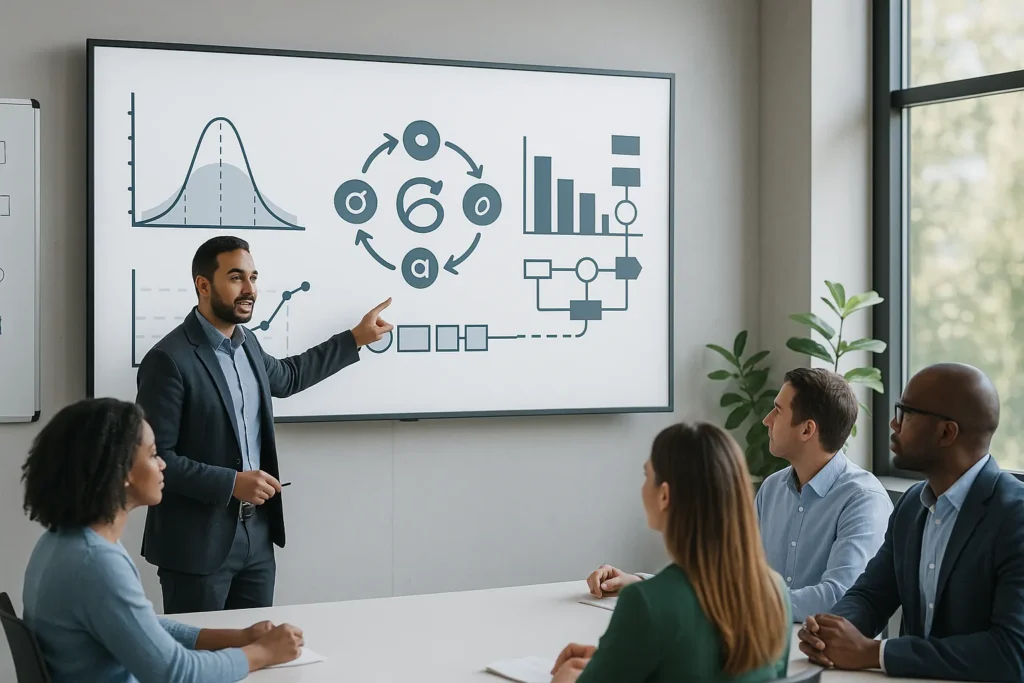
Our face to face sessions include interactive workshops and activities that emphasize hands on learning and engagement.
Learners benefit from direct interaction with experienced instructors who deliver personalized guidance and feedback.
The in person experience fosters peer collaboration and practice, creating a strong and supportive learning community.
Virtual Training
Our virtual programs assist organizations across the United States, covering both major metros and regional teams.
These programs let participants learn from any location while keeping pace through live sessions and office hours.
Interactive components such as polls, discussions, and practice data sets ensure online learning is engaging and effective.
How Do We Customize Our Training Programs?
We customize programs by defining your company’s needs and goals, tailoring the syllabus to your industry, and integrating real life scenarios and case studies.
Understanding Your Company’s Needs and Goals
We begin with a detailed consultation to understand what matters most to your business.
Stakeholder interviews plus surveys or assessments uncover current obstacles and opportunities.
The results prioritize improvements, surface skill gaps, and guide the strategy to close them.
Tailoring the Curriculum to Suit Your Industry
We align the curriculum with your industry so content remains relevant and adheres to applicable standards.
Knowledge of sector pressures helps us select cases, data points, and terms that resonate with your teams.
Incorporating Real Life Scenarios and Case Studies
Real life scenarios and case studies ensure every concept connects to on the job use.
Experiential work turns principles into repeatable practices.
Participants trial methods safely before applying them to real projects.
Case studies expose real world complexity and practical trade offs.
This builds critical thinking, problem solving, and confident decision making.
What Is Our Training Approach?
We use an interactive approach that blends workshops, simulations, and individualized coaching with feedback to ensure meaningful learning and measurable skill growth.
Interactive Workshops and Activities
Our workshops emphasize hands on practice that drives engagement and application.
Participants work through structured exercises and group discussions that promote collaboration and creativity.
The format is designed to yield clear insights and actionable takeaways.
By using real scenarios, learners apply new methods right away, boosting retention and comprehension.
This interactive design fosters active participation and practical problem solving.
Role Playing and Simulations
Role playing and simulations give participants the chance to practice real situations without risk.
Individuals rotate roles to build communication skills and empathy while using tools such as 5 Whys and fishbone diagrams.
Teams rehearse process walkthroughs, handoffs, and stakeholder reviews to streamline flow.
These sessions strengthen confidence, teamwork, and decision making.
The immersive format connects classroom concepts to on the job use.
One on One Coaching and Feedback
One to one coaching is central to our model and provides personalized guidance and support.
Participants receive targeted recommendations and constructive feedback to accelerate progress.
Coaching expands understanding and sustains growth by aligning to strengths and development areas.
Direct access to an experienced coach offers a safe space for questions and reflection.
This focused attention enables real world application of new skills.
The result is higher performance and lasting mastery.
Frequently Asked Questions
What is Six Sigma Training?
Six Sigma Training equips professionals with methods to remove defects, reduce variation, and improve process performance.
The curriculum teaches how to define issues, measure baselines, analyze drivers, implement improvements, and maintain control.
Why is Six Sigma Training important?
It offers a disciplined, data based framework for solving tough challenges and keeping quality consistent.
Leaders improve communication, decision making, and problem solving, gaining confidence to guide change.
What makes us the best company for Six Sigma Training in the United States?
We combine expert instructors, a tailored learning journey, and programs tied to business results.
Content and exercises are adapted to each organization and learner profile.
We deliver in multiple formats to match different learning preferences and time constraints.
What can I expect from a Six Sigma Training program?
Expect hands on tools you can use on day one.
We cover DMAIC, root cause analysis, measurement system analysis, and control plans.
Our aim is to prepare you to deliver measurable improvements with confidence.
Who can benefit from Six Sigma Training?
Anyone responsible for processes can benefit, including supervisors and executives.
Programs support individuals at all levels and teams committed to improvement.
We also run custom pathways to build Green Belt and Black Belt capability across the company.
Find More Info
Reach out today to explore how our Six Sigma training programs can strengthen your team across the United States.
Here are some of the other area’s we cover nearby: Commerce, Crestwood, Campbell, Clive, Urbandale, Lakewood

The DMAIC workshops gave our ops team a clear path to fix defects fast. We cut rework by 32 percent in eight weeks and customer complaints dropped.
Taylor Jennings
Dallas
The hands on stats coaching made control charts finally click. We now catch variation early and our on time delivery is the best it has been in years.