Six Sigma Training Wood Dale
Enquire Today For A Free No Obligation Quote
Welcome to Six Sigma Training US, a trusted leader in process improvement and quality management.
We provide comprehensive Six Sigma programs throughout the United States. Our accredited instructors craft tailored programs and use a practical hands on method that accelerates team growth.
Training outcomes include fewer defects and less variation, higher customer satisfaction and ROI, and stronger problem solving and data driven decisions. Delivery formats include in person, virtual, and on site sessions aligned to your goals.
From dynamic workshops and simulations to focused one on one coaching, our programs deliver results you can see. Drive operational excellence and elevate performance with Six Sigma Training.
What Makes Us the Best Six Sigma Training Provider in the United States?
We are known for high quality, results driven programs that produce confident, capable practitioners. Our courses align to industry standards and hold recognition from respected organizations such as the International Association for Six Sigma Certification and ASQ.
Our Experienced and Qualified Instructors
Our instructors are experts in Lean and Six Sigma, providing rigorous content and practical coaching to every participant.
They bring experience from manufacturing, healthcare, technology, finance, and service settings, broadening perspectives in the classroom.
Time spent in corporate, nonprofit, and public sector roles gives them a comprehensive view of process improvement.
That range allows them to tailor guidance to specific needs and challenges, resulting in an engaging learning experience.
Our Tailored Training Programs
Programs are customized with flexibility so the approach fits your organization, drawing on DMAIC, DMADV, and Lean techniques.
We start with an assessment to align on metrics, pain points, goals, and organizational culture.
We then identify priority processes and capability gaps and design a training and project roadmap to address them.
Our modular structure lets you combine topics so cohorts receive training aligned to roles and business targets.
We fine tune delivery and depth as needed to ensure strong results.
Our Focus on Practical Application
Our Six Sigma training is built for real world use. We leverage practical tools, real data sets, and interactive scenarios for immediate application.
Case study analysis and root cause exercises strengthen confidence and capability in a supportive environment.
What Are the Benefits of Our Six Sigma Training?
Our programs offer numerous benefits, including:
- Stronger communication with better cross functional collaboration
- Higher employee engagement and reduced turnover
- More effective problem solving and decision making
- Significant improvements in performance and quality
Improved Communication and Teamwork
Our courses establish common improvement terminology and clarify project roles, which boosts communication and teamwork.
Effective communication means shared understanding of the voice of the customer, CTQs, and process capability levels.
Training develops active listening, clear data presentation, and structured updates that support a productive culture.
Teams work through value stream maps, FMEAs, and action plans to advance individual skills and organizational results.
Increased Employee Engagement and Retention
Empowering employees to solve meaningful problems through Six Sigma raises engagement and retention.
Leaders who coach, give constructive feedback, and clear obstacles help people feel respected and motivated.
This connection between developing capability and engagement increases satisfaction and commitment.
Organizations that support Six Sigma experience greater participation in improvement projects and improved retention of skilled staff.
Enhanced Problem Solving and Decision Making Skills
Our training builds decision quality and problem solving with DMAIC, statistical thinking, and visual management.
Leaders address complex issues, from flow constraints to quality failures, using data and structured methods.
Earlier and better decisions shorten cycle time, reduce waste, and spark innovation.
These capabilities help teams align projects with business priorities and rely on evidence to seize opportunities and sustain gains.
What Are the Different Types of Six Sigma Training We Offer?
We provide multiple options to fit different learning preferences and organizational requirements, including face to face training, virtual training, and on site programs.
In Person Training
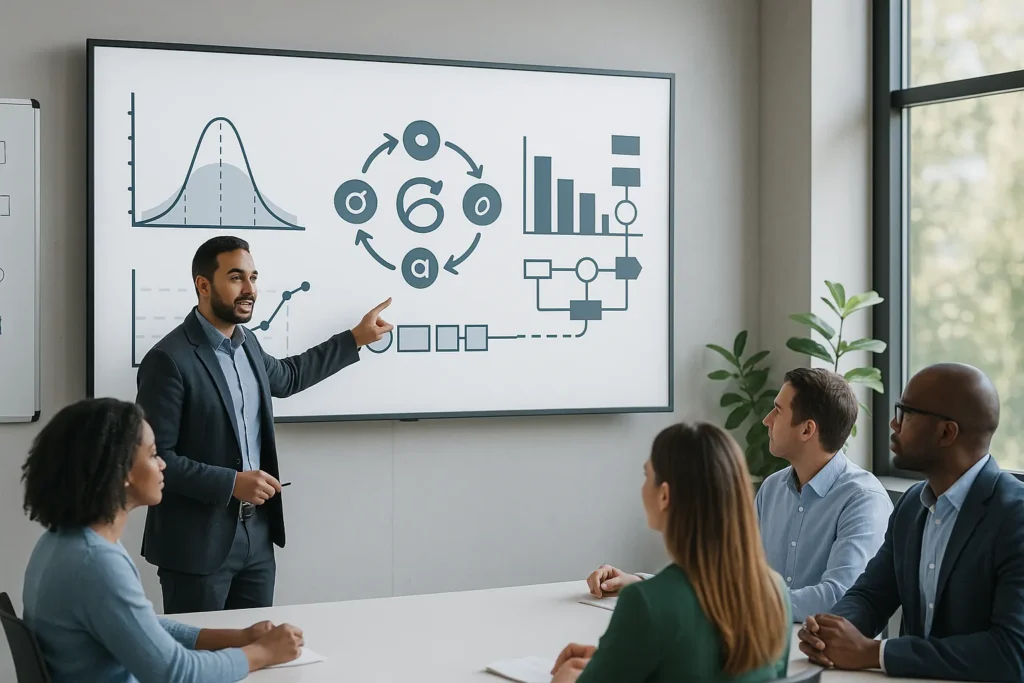
Our face to face sessions use interactive workshops and activities designed for hands on learning and high engagement.
Attendees benefit from real time interaction with experienced instructors who offer personalized guidance and feedback.
The in person environment creates room for peer collaboration and practice, building a connected learning community.
Virtual Training
Our virtual programs serve organizations throughout the United States, supporting both metro hubs and regional teams.
These programs enable flexible learning at any location while maintaining momentum with live sessions and office hours.
Features like polls, discussions, and practice data sets make the online experience interactive and effective.
How Do We Customize Our Training Programs?
We customize programs by clarifying your company’s objectives, tailoring the syllabus to your industry, and weaving in real life scenarios and case studies.
Understanding Your Company’s Needs and Goals
Customization begins with a focused discovery session to confirm needs and goals.
We collaborate with stakeholders and use surveys or assessments to capture current pain points and opportunities.
The findings reveal where to improve, identify capability gaps, and inform the right action plan.
Tailoring the Curriculum to Suit Your Industry
We shape the curriculum for your industry so content stays relevant and meets applicable standards.
Sector insights guide our use of cases, benchmarks, and terminology that align with your teams.
Incorporating Real Life Scenarios and Case Studies
Real life scenarios and case studies translate learning into on the job application.
Interactive practice turns ideas into usable skills.
Participants trial methods in a low risk environment before addressing similar work challenges.
Case studies surface real constraints and common trade offs across industries.
This approach builds critical thinking, problem solving, and confident decisions.
What Is Our Training Approach?
Our methodology is interactive by design, integrating workshops, simulations, and one to one coaching with feedback to ensure effective learning and skill adoption.
Interactive Workshops and Activities
Workshops center on hands on exercises that translate ideas into practice.
Participants engage in activities and group dialogue that encourage collaboration and creative thinking.
A well planned structure produces meaningful insights and clear takeaways.
Realistic scenarios let learners apply new tools immediately, improving recall and understanding.
The interactive setting supports active participation and practical problem solving.
Role Playing and Simulations
Simulations and role playing provide a safe environment to rehearse real world challenges.
Participants adopt multiple perspectives to strengthen communication and empathy while using 5 Whys and fishbone diagrams.
Teams practice process walkthroughs, handoffs, and stakeholder checkpoints to improve flow.
These activities build confidence, teamwork, and sound decision skills.
Immersion ensures classroom learning transfers to daily work.
One on One Coaching and Feedback
Individual coaching sessions are a cornerstone of our programs and offer tailored support.
Participants receive precise guidance and constructive feedback that advances their goals.
Coaching deepens insight and supports continuous growth based on strengths and opportunities.
Time with a seasoned coach provides a safe space for questions and reflection.
This focused approach helps learners apply new knowledge to real situations.
The net effect is better performance and sustained mastery.
Frequently Asked Questions
What is Six Sigma Training?
Six Sigma Training equips professionals with methods to remove defects, reduce variation, and improve process performance.
The curriculum teaches how to define issues, measure baselines, analyze drivers, implement improvements, and maintain control.
Why is Six Sigma Training important?
It offers a disciplined, data based framework for solving tough challenges and keeping quality consistent.
Leaders improve communication, decision making, and problem solving, gaining confidence to guide change.
What makes us the best company for Six Sigma Training in the United States?
We combine expert instructors, a tailored learning journey, and programs tied to business results.
Content and exercises are adapted to each organization and learner profile.
We deliver in multiple formats to match different learning preferences and time constraints.
What can I expect from a Six Sigma Training program?
Expect hands on tools you can use on day one.
We cover DMAIC, root cause analysis, measurement system analysis, and control plans.
Our aim is to prepare you to deliver measurable improvements with confidence.
Who can benefit from Six Sigma Training?
Anyone responsible for processes can benefit, including supervisors and executives.
Programs support individuals at all levels and teams committed to improvement.
We also run custom pathways to build Green Belt and Black Belt capability across the company.
Find More Info
Reach out today to explore how our Six Sigma training programs can strengthen your team across the United States.
Here are some of the other area’s we cover nearby: Bensenville, Addison, Elk Grove Village, Elk Grove, Elmhurst, Villa Park

The DMAIC workshops gave our ops team a clear path to fix defects fast. We cut rework by 32 percent in eight weeks and customer complaints dropped.
Taylor Jennings
Dallas
The hands on stats coaching made control charts finally click. We now catch variation early and our on time delivery is the best it has been in years.